Choose an indoor drying rack for the load and the room
Compare hanging length, garment drop, flat drying space, and the room a loaded rack needs.
As an Amazon Associate I earn from qualifying purchases. How our shopping links work.
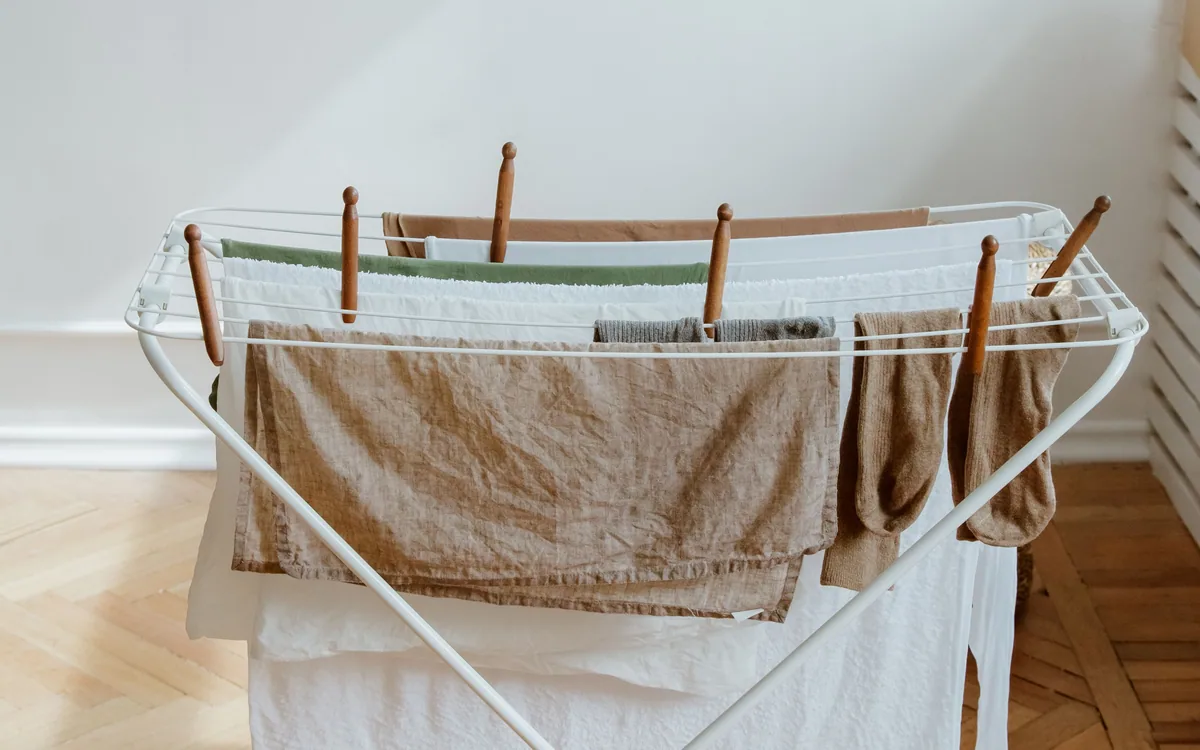
The short answer
Choose a rack around one real wash load and its longest garments. Check open working space and folded storage separately.
Plan the load before counting the rods
A drying rack needs to accommodate the clothes you take out of one wash. Spread that load on a clean surface and separate the pieces that hang over a bar from those whose care labels call for flat drying. A rack with plenty of rods can still leave a sweater without a suitable support surface.
Make a short inventory using your own laundry: full-length pants, shirts, smaller items, and any piece that needs its own flat area. Keep this list beside the product dimensions. It gives a more useful comparison than a manufacturer's approximate garment count, since ten pairs of socks occupy space differently from ten bath towels.
If laundry regularly finishes late in the evening, include the room's overnight use. A rack that fits beside a dining table may block the chair you need at breakfast. Choose its location before choosing its size.
Compare hanging length with the open footprint
Manufacturers may describe capacity in linear feet. That figure adds up the hanging bars; it does not describe the clear floor space around the rack or the size of an individual drying surface.
Honey-Can-Do lists its DRY-09065 accordion rack with 24 linear feet of drying space and open dimensions of 29 by 14 by 42 inches. Its DRY-09805 wing rack lists 42 linear feet and measures 57 by 23.5 by 38.5 inches. These are examples of different layouts, rather than evidence that either fits a particular washer load.
Draw the open dimensions on paper, including raised wings. On the floor, use removable markers to outline the rack in its intended position. Walk from the doorway to the closet and try opening nearby furniture. Leave space for your hands to reach the inside rods; the product rectangle alone does not include that working area.
Check where long garments will end
The overall height can include a section that you cannot use for a long hanging item. Find the height of the actual bar you expect to use, then compare it with the garment's hanging drop.
For a simple fit exercise, suppose a shirt measures 30 inches from its fold over a rod to its lowest edge. A bar 28 inches above the floor cannot hold that arrangement clear of the floor. Folding the shirt differently changes the required drop, but it also puts more fabric over the bar. This is a planning example, not a drying-time prediction.
Check pants in the same way. An accordion rack's upper bars may provide useful clearance while lower bars suit small pieces. On a wing rack, the slope changes the available drop along the wing. Read the diagram and work out which bars your longest items would actually occupy.
Give flat-dry pieces a separate place
Look for a supported mesh shelf or a manufacturer-approved flat drying area when your garments need one. Honey-Can-Do's DRY-09805 includes a lay-flat mesh shelf. Its existence does not settle whether the usable area fits your particular sweater spread to the shape required by its care instructions.
Measure the garment while it is laid out. Compare both dimensions with the shelf, allowing for anything that would hang over an edge. A narrow platform may support the body but leave sleeves dangling. Plan another suitable flat drying surface if the fit fails.
Do not translate a general rack load rating into permission to hang every delicate garment. The item's care label and the rack's permitted loading arrangement answer different questions.
Allocate space between the pieces
Use paper strips or dry laundry to sketch one realistic arrangement. Start with the pieces that are hardest to place, then add the smaller items. Leave visible gaps instead of packing every bar.
Scroll to compare
| Part of your load | Question to settle before buying |
|---|---|
| Long pants | Is there enough drop on an accessible bar? |
| Wide towel | Which bars remain usable beside it? |
| Flat-dry sweater | Does the support area fit the whole garment? |
| Socks and small pieces | Can you reach their rods after loading larger items? |
| Damp heavy pieces | What loading limit and distribution does the manual permit? |
A model's published maximum weight applies to that model under its instructions. DRY-09805 lists a 50-pound capacity; that does not establish the limit of an accordion rack or prove how quickly a heavy load will dry. Neither product page supplies a drying time for your room.
Rehearse folding and storage
Both example racks advertise a folded thickness of about 3 inches. You still need their folded height and width, plus room to lift and turn them. A narrow gap behind a door can be deep enough yet too short for the folded frame.
Watch the manufacturer's folding instructions before ordering. Identify the latch or brace, where your hands go, and where you will set the rack while closing it. Keep a freestanding rack in its documented open configuration during use, and follow its placement and loading instructions.
Choose the layout that holds your difficult garments and leaves the room usable. For the preceding laundry step, the HE detergent guide explains how to match dosing to the washer. Once clothing is completely dry, the seasonal storage comparison covers a separate decision: how often you will reopen it.
We may earn a commission from qualifying purchases.
Keep your wash-load plan and room measurements beside you when comparing another rack.
Browse Amazon Best Sellers Explore indoor drying racks on AmazonOpens Amazon.com. Check open and folded dimensions, garment support, and the exact loading instructions. Check the exact model, seller, and current terms before ordering.
A useful next read.
Keep the whole purchase in view.

Choose HE detergent for your washer and dosing routine
Match the detergent format, concentration, and measuring method to the exact washer dispenser.
Read the guide
Storage bins or vacuum bags for seasonal clothing
Match seasonal textile storage to care instructions, compression limits, and how often you will reopen the group.
Compare the options
Velvet or plastic hangers: match the garment and the rail
Compare shoulder width, surface grip, strap supports, and the space your clothes occupy on the rail.
Compare the options